Implement VRP in 5 minutes
Become node #2.
One node is a file format. A second independent node — signing its own offers on its own domain — is a standard.
VRP has no registry, no API key, no gatekeeper, and nothing to sign up for. You publish two static files and one signed JSON response from your own domain, and any agent can verify you directly. This page hands you a working Ed25519 signer right in your browser and the reference code (Apache-2.0) to run it in production.
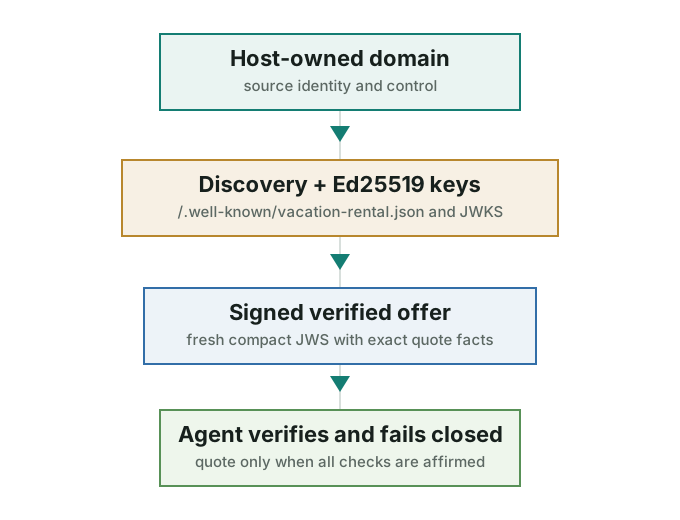
The whole protocol, in five steps
A VRP node is just three documents served from your own domain. There is no central server to register with — the host-owned domain is the source of truth.
-
Generate an Ed25519 key pair.
Keep the private key on your server; the public key goes in your
JWKS. Use the in-browser generator below, or
openssl genpkey -algorithm ed25519/generateKeyPairSync("ed25519"). -
Publish your JWKS.
Serve the public key as a JWKS at
https://<your-domain>/.well-known/jwks.json. -
Publish a discovery document.
Serve
https://<your-domain>/.well-known/vacation-rental.jsonpointing at your JWKS and your offer endpoint. -
Sign verified stay offers.
For each stay request, build a
verified_stay_offerwith live availability, the exact total price, avalid_untilwindow, and a direct booking URL on your own domain — then sign it as a compact JWS. -
Return the signed envelope.
Expose your offer endpoint (e.g.
/api/verified-stay-offer) returning thesigned_verified_stay_offer. Done — agents can now verify you with no help from anyone.
Fail closed: when you cannot satisfy a request, return an explicit
signed available: false — never an unsigned or partial
answer. See the
core spec (v0.1) and the
implementation guide.
For coding agents (Claude Code, Cursor, Codex)
- Publish three documents on the host's own domain:
/.well-known/jwks.json,/.well-known/vacation-rental.json, and the offer endpoint it names, e.g./api/verified-stay-offer. - Do not invent a schema — use spec/v0.1.md and schemas/ verbatim.
- Do not proxy booking through a marketplace —
direct_booking_urlstays on the host's domain. - Prove interop with the conformance vectors (
npm test). - Questions: hello@vacationrentalprotocol.com
Copy-paste signer — sign a real offer in your browser
This runs entirely in your browser with native
Web Crypto Ed25519. No library is loaded, nothing is
sent anywhere, and HemmaBo's servers play no part. Fill in your
details, sign, and you get the exact three files a VRP node serves —
plus a live signature check so you can see it verify.
A fresh Ed25519 key pair is generated the first time you sign. In production you generate the key once and reuse it — paste the private key into your server (see below), keep the public key in your JWKS.
Reference code (Apache-2.0)
The browser signer mirrors the canonical construction exactly:
base64url(header) + "." + base64url(payload) signed with
Ed25519, where the header is
{ "alg": "EdDSA", "typ": "JWT", "kid": "<your-kid>" }.
Here is the same logic as a zero-dependency Node.js module you can
drop into production:
import { generateKeyPairSync, createPublicKey, sign } from "node:crypto";

// Generate ONCE, then persist privateKey securely and reuse it.
const { privateKey, publicKey } = generateKeyPairSync("ed25519");
const kid = "my-stay.example-vrp-2026";

const b64url = (b) => Buffer.from(b).toString("base64url");

export function jwks() {
  const { x } = publicKey.export({ format: "jwk" }); // { kty, crv, x }
  return { keys: [{ kty: "OKP", crv: "Ed25519", kid, use: "sig", alg: "EdDSA", key_ops: ["verify"], x }] };
}

// offer = a verified_stay_offer payload object (see schema)
export function signOffer(offer) {
  const header = { alg: "EdDSA", typ: "JWT", kid };
  const signingInput = `${b64url(JSON.stringify(header))}.${b64url(JSON.stringify(offer))}`;
  const signature = sign(null, Buffer.from(signingInput), privateKey);
  return `${signingInput}.${b64url(signature)}`; // compact JWS
}
verifyCompactJws(jws, jwks) → { header, payload, kid }
Signing + verification reference — scripts/conformance.mjs
signOffer(offer) · verifyCompactJws(jws, jwks)
JSON Schemas (CC0) — validate your documents
discovery · jwks · verified-stay-offer
License boundary: the specification text and schemas are CC0-1.0 (public domain — implement freely); the reference code and conformance vectors are Apache-2.0, which includes a royalty-free patent grant (§3).
Conformance vectors — prove your verifier interops
The repo ships real, reproducible Ed25519 / compact-JWS vectors so an
independent implementation can load the JWKS, verify the signed
offer, and reproduce the exact result — including the failure modes
(tampered payload, wrong key, unknown kid, expired
window). Run them with npm test (or
npm run verify-vectors).
examples/conformance/
Signed verified-stay-offer vector
verified-stay-offer.signed.v0.1.json
JWKS for the vector
jwks.v0.1.json
Three-state behavior fixtures (Affirmed / Negated / Unknown)
three-state-verification.v0.1.json
Implemented a node? VRP has no registry to add yourself to — that is the point. Just publish, and (optionally) tell us at hello@vacationrentalprotocol.com so we can link independent implementations.